
Dentaderm @ The New Normal
Dental Clinics in the Philippines were allowed to operate last June, 2020 as the economy tries to reopen and jumpstart again after the series of quarantine conditions. Initially, patients were rather hesitant to avail of such services in fear of contracting the dreaded COVID-19 virus. However, Dentaderm Clinics assure their patients that they highly comply with the IATF Protocols to totally make their services safe and effective.
Dentaderm adopted to the NEW NORMAL in terms of service and compliance of onsite accommodation of customers. In this video, we can see how Dentaderm attendants and doctors are properly attired to comply with the IATF Standards in operating a dental clinic. Here, Dentaderm gives us a glimpse on how they attend to clients and how they closely observe the IATF Protocols given the still current situation of the pandemic.
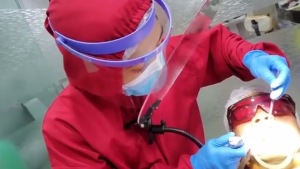
Based on IATF Protocols in observing social distancing and avoiding overcrowding of patients in the clinic, Dentaderm now accepts patients thru reservation as much as possible avoiding walk-ins to regulate the inflow and outflow of patients in the clinic. This will control the flow of patients in and out of the clinic avoiding the possibility of overcrowding. Although, Dentaderm will still accommodate emergency cases such as patients experiencing tooth pain or swelling are immediately given treatment. All patients have to fill out our contact information forms indicating their personal information for contact tracing purposes before showing up at the clinic.
The clinic’s reception and treatment area are now covered with medical-grade plastic sheets. They have removed waiting rooms, provided alcohol and sanitizers, installed air purifiers, and utilized PPE — which is changed after treating every patient, she added.
Dentaderm also observes regular ultraviolet disinfection process of the spaces, machines and equipment. They regularly sanitize tools and properly disposes of used items to avoid unnecessary contact with other foreign objects.
Dentaderm knows that it’s important to maintain the trust and confidence of patients by taking steps to demonstrate that they place their health and safety above all. Dra. Joyce Ambray also believes that patients will keep seeing dentists because more Filipinos now understand the value of good oral hygiene.

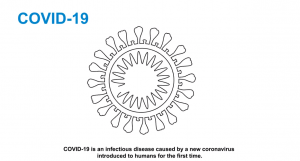

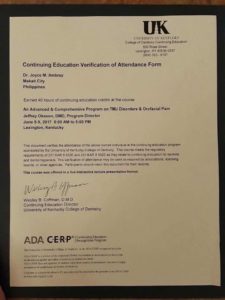
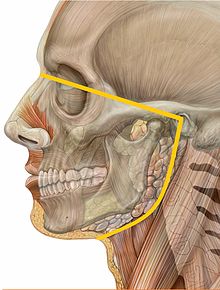 Complexity in TMD and orofacial pain arises from the many problems that can be associated with masticatory function. To effectively manage TMD and orofacial pain disorders the clinician must be able to recognize these disorders from other orofacial pain disorders so that correct treatment can be selected. This course completed by
 Braces Prevent Cavities. True enough, having better aligned teeth makes it easier to remove food trapped in-between teeth. Properly spaced and aligned teeth minimizes hard to remove food particles by simply allowing a toothbrush to do its work or for hard to remove food items (beef, pork, etc.), it is easier to floss as compared to flossing crookedly aligned teeth.
 Braces Prevent Gum Disease. Gums cannot properly support a tooth when crookedly aligned resulting to gum disease. This weakens the gums around the tooth allowing foreign particles and bacteria to reside between them. This normally result gingivitis… or worse… periodontitis. Properly aligned and spaced teeth allow the gums to firmly hold each tooth eliminating unnecessary spaces where bacteria and foreign food particles may get trapped and eventually cause discomfort.
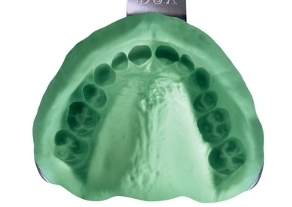 Polyvinyl siloxane (PVS), an addition-reaction silicone elastomer, is widely used in dentistry as a dental impression material. It was commercially introduced in the 1970s. This is a viscous liquid that molds quickly into a rubber-like solid, taking the shape of whatever surface it was lying against while curing. As with two-part epoxy, its package keeps its two component liquids in separate tubes until the moment they are mixed and applied, because once mixed, they cure (harden) rapidly.
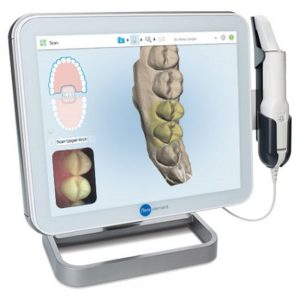 However, technology has taken vast improvement over PVS impressions. The iTero™ Intraoral Scanner provides increased impression accuracy for better fitting aligners and restorations. It brags of lower rejection rates and lesser fitting issues.
 connectivity. iTero™ open format STL files also can be integrated with third party CAD/CAM systems, CT scan files and digital orthodontic services allowing development of surgical guides and same-day temporization.
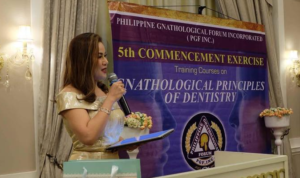 The Philippine Gnathological Forum (PGF), Inc. invited
 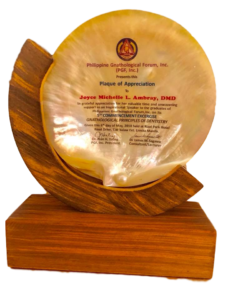 of PGF, Inc.
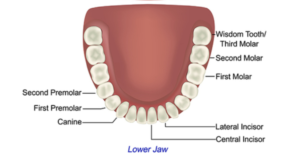 The wisdom tooth is commonly described as the last molar of both the left and right sides of the upper and lower jaws. They can also be termed as the third molar in the sequence. Some would say it is the most popular tooth but yet it would also be described as the least performing tooth (if not totally useless) of all. Apparently, they are the last to emerge normally during later stage of teenage life and for some, at the early stage of adulthood. During its emergence, it is usually accompanied by a slight pain and sometimes with a slight fever due to the process of its protrusion to the gums.
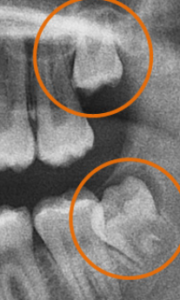 A common problem with wisdom teeth is impaction. Impaction can be described as the failure of the tooth to protrude normally such that it may position itself under another tooth or worse, emerge diagonally pushing on to the tooth immediately beside it. This may cause the erupting tooth to show partially or not at all, having itself embedded just below the gum line and jawbone. Such occurrence may be accompanied by pain and at times, causes tooth damage to both protruding and surrounding teeth.
 For this problem, a procedure that can be performed immediately is called Odontectomy. Odontectomy is a dental surgical procedure done on impacted tooth. The procedure includes cutting into the gums to expose the impacted tooth and bone area covering the tooth. In some cases, the procedure may include drilling into the bone to access the tooth more easily. Sections of the tooth may be removed piece by piece as forceps are used to keep the socket open. Serious cases may require general anesthesia. However, in regular cases, local anesthesia will be enough to complete the procedure. There will be instances that the root may be left behind deliberately. This is called partial Odontectomy or Coronectomy where only the crown of the tooth is eventually removed leaving behind the root. This procedure requires lesser or may totally eliminate the use of drilling into the bone which means faster procedure and less invasive action into the patients bone and gum areas.